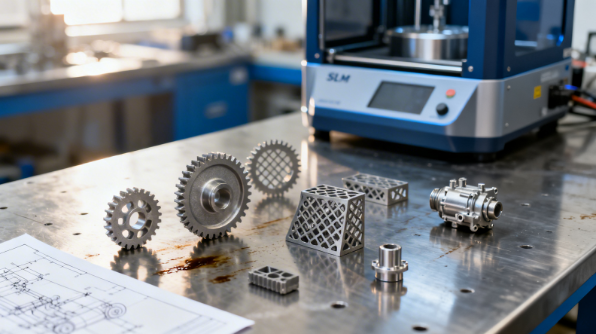
Selective Laser Melting is a metal powder bed process that fully melts fine metal particles using a concentrated high energy laser beam. Unlike surface level bonding methods, this technology completely liquefies the powder in selected areas, allowing each layer to solidify into a fully dense metallic structure. The result is high performance components with mechanical properties that closely match, and in some cases rival, traditionally forged metals.
This method allows engineers to rethink design limitations that previously depended on machining or casting constraints. Instead of removing material from a solid block or relying on molds, parts are built layer by layer directly from a digital design. This opens the door to complex geometries that would be impossible or extremely expensive with conventional manufacturing.
Structural Integrity and Density
With SLM 3D printing, each metal layer is completely fused to the previous one, creating near 100 percent dense parts. This full melting process eliminates internal voids and weak bonding zones, ensuring excellent tensile strength, fatigue resistance, and long term durability.
The technology supports materials such as stainless steel, titanium alloys, aluminum alloys, cobalt chrome, and tool steels. These materials are widely used in demanding engineering sectors where structural integrity and corrosion resistance are critical. Because of its precision and density control, SLM is trusted for components that must perform under extreme pressure, temperature variation, or mechanical stress.
See also: Power and Performance: Key Technical Specs to Look for in Big Rice Mill Machines
Applications in Aerospace and Medical Fields
SLM is widely used for aerospace brackets, turbine components, lightweight housings, and structural elements where weight reduction without strength compromise is essential. The ability to create topology optimized designs allows engineers to remove unnecessary mass while maintaining mechanical reliability.
In medical industries, it enables the production of customized implants, orthopedic components, and surgical tools under precision metal additive manufacturing standards. Patient specific implants can be designed based on scan data, ensuring better anatomical fit and improved clinical outcomes.
The ability to integrate internal cooling channels, lattice structures, and complex internal geometries significantly improves performance while reducing overall weight. These features are often impossible to achieve through traditional casting or machining.
Advantages Over Traditional Manufacturing
Unlike casting, SLM minimizes material waste because metal powder is only melted where required. Unused powder can often be recycled for future builds, improving cost efficiency. Additionally, the need for multi part assembly is reduced since complex shapes can be built as a single consolidated component.
This consolidation lowers failure risk, improves structural efficiency, and reduces assembly time. Tooling costs are also eliminated, allowing faster design iterations and shorter product development cycles. For industries focused on innovation and performance, SLM provides a modern alternative to conventional metal fabrication methods.
FAQs
Is SLM suitable for high stress applications?
Yes, SLM produces dense metal parts with high mechanical strength, making them suitable for extreme load bearing and high stress environments.
What industries benefit most from SLM?
Aerospace, automotive, medical, energy, and defense industries frequently use this technology for critical performance components.
Does SLM reduce production time?
It eliminates tooling requirements and reduces assembly complexity, which significantly speeds up development and production timelines.
For more information on 3D printing projects, visit KAD 3D.