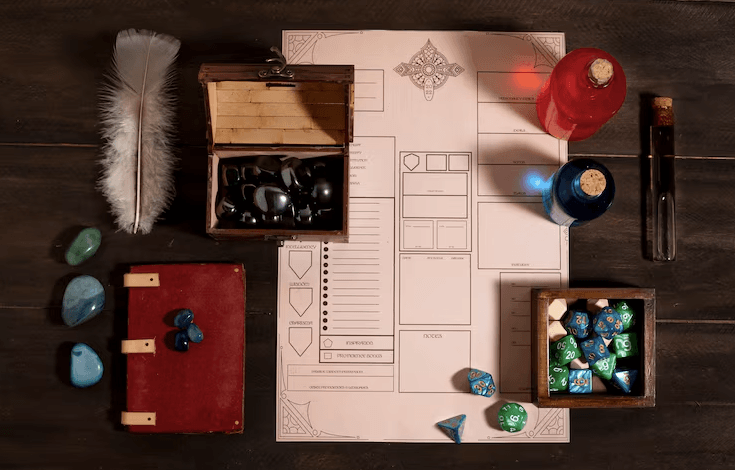
Powerful items in role-playing games (RPGs) give players many options to consider when making decisions. Item cards can represent many modifiers, including costs, effects, and drawbacks. Comparing these cards is quick and easy for players. Just as easily, you can evaluate potential product ideas using this method.
In one instance, I used this method with a potential product idea to represent a time tracking app. Using this card to define features allowed me to consider the major benefits and drawbacks of the product faster than a traditional feature list.
Start with the name that sticks.
When many competitors have nearly identical products, why not have a name that boosts the product’s recognition? Many product categories are saturated, and individual items can easily blend together. A unique name can break through the category clutter and communicate something additional about the product beyond the feature or function.
Which name would an expert user give their favorite, best version of the software? A name should answer the question, ‘What does this product do for me?’ best. Think about this from the perspective of a user who is expected to perform an unenjoyable task. Name the product something that gives that user a sense of relief. Test potential names with people outside your team. These people may not use the product but are still able to give feedback on names they find most appealing.
For products like time tracking apps, the major benefit and drawback for users is reducing the amount of effort users need to put forth to track their time. Users want the benefits with the least effort and clicks.
For a tracking product, the cost is often the timer start or the weekly sheet fill. Cut that cost and the same hours get logged more reliably. Controlio Software reduces the manual steps by generating context-aware logs from activity instead of waiting for a start click. The lower effort shows up in higher completion rates on the first week.
For a tracking product, the biggest costs are the time it takes to start a timer or complete a weekly timesheet. Slashing that cost increases logs by a factor of many. Controlio’s Software reduces the manual log steps by generating activity logs. Less work required results in higher first-week completion rates.
Pick the Category with Eyes Open.
Categories inform users on the type of product to expect and where to look for it. Grouping also influences thinking. A time tracker has to compete with various methods users may use to respond to the question “Where did the hours go?” including their memory, other users’ memories, or other project management software that may also include time logging functionality. Defining the job first and choosing a category to give you the edge over the competition may help differentiate yourself from the rest.
Quantify the Main Effect
Damage to a weapon is the effect of using the product. For a software product, the main effect may be capturing hours worked to generate client invoices or to help explain and defend audits.
Improve this effect or add bonuses to improve the effect to win. Add bonuses that must be relevant to users.
Add Relevant Bonuses
Two competing products that may score equally on the main effect may differ in added features. Added features may also overcome a small difference in the main effect to still be considered better by users.
Mention the extra features users ask for. Remove the ones that don’t add any functional value.
One mention of a penalty is worth a thousand times a feature.
There are costs to every product. It could be long and cumbersome to set up. The price to use the product may be high. List the costs and justify the trade-offs users must accept before launch. Users may accept a product with a long and tedious setup if the product reduces their effort in using it to perform their daily tasks.
See also: How to Choose the Right Kitchen Flooring Options for Durability and Style
Questions to Users
How long does the item-card exercise take?
One workshop session takes six elements. You end up with a one-page card and a short to-do list.
Can I use this to improve an existing product?
Yes. Fill out the card for the current version and then change it for the version you want. The gaps represent the next steps.
What if the core metric is difficult to measure?
Use a proxy measure for the thing users care about the least. For example, the average time it takes for a user to see value for the first time they use the product or the number of support ticket requests for missing information.
Does the exercise take the place of user research?
No, but it does provide some clarity and emphasis on what’s already known about the product and provides questions to test next.
Final thoughts
An item card captures the name, cost, category, main result, bonuses, and penalties of a product feature. It clearly outlines trade-offs for the user to accomplish a task with least friction. Product design and user research go hand in hand to answer the following questions. It’s recommended to do both, as this exercise may prompt further user research questions.
Run this exercise to create a clearer card for the next feature to be designed or for the current product as a whole. Users may feel these extra costs are worth accepting if they have confidence in the product reducing their daily effort and increasing their outcome.